Picture
Never mind tacos. What’s in your grass seed?

So there’s a little oatmeal in your Taco Bell taco meat. Big deal. But filler in your grass seed? That’s just plain unconscionable.

At least, that’s what grass seed marketer Pennington wants you to believe about Scotts EZ Seed brand grass seed with “Water Smart.” And, apparently, it’s also what Scotts wants you to believe about Pennington.

Scotts advertising claims that Water Smart “technology” is an “exclusive coating that keeps the seed moist twice as long as uncoated seed, so it’s more likely to grow in rather than drying out.” 

Overlooking Scotts’ blatant disregard for parallelism, Pennington advertising calls the Scotts product “10 pounds of seed and 10 pounds of filler,” and assures us that their own product delivers an “Honest Green.” 

Scotts has fired back that Pennington markets a natural mulch that is naught but ground-up paper: “That’s right. Paper, which can’t come close to surrounding the seed with water the way EZ Seed can.”

With one drive past my house, you will know that I am not a lawn fanatic. I don’t care whose seed is better. Just keep them both out of my tacos.

—Steve Cuno
 
 
New Aflac spokesduck

Being fired for cause can be embarrassing. How much more so when you’re fired from being a duck? 

Aflac canned erst voice-of-duck Gilbert Gottfried. The new duckvoice-supplier is one Dan McKeague, a sales manager for two Minneapolis radio outlets. He was chosen out of 12,500 competitors. Click here if you’d like to watch Aflac’s delightful new announcement commercial and hear McKeague’s duckpipes.

Gottfried exercised his right of free speech by making light of the recent calamities in Japan. Aflac exercised its right to fire him for it. Good for Aflac. I would hope their decision was for the most part motivated by decency and compassion, though I suspect that the fact that 75% of Aflac’s revenues come from policyholders in Japan is not coincidental.

—Steve Cuno
 
 
Lesson from a urinal
(Gotta love this  job. How often does anyone get to write a headline like that one?)

Once upon a time in another office building, there was a problem. A good many of the men working in said building had apparently inherited the Flush Inhibitor Gene (FIG). Whenever enough FIG-carriers in a row left their, er, contribution, it became possible for anyone else to locate the mens room blindfolded.

So I created a sign. It was a tad sarcastic, and failed to effect any change. So next I took a lighter approach. I put up a nicely designed sign that said: “To urinate is human. To flush is divine.” It worked.

If you’re wondering what brought this to mind, please read this post about a tasteless sign and a poor leadership example. The post was written by my friend, associate and former creative director Ty Kiisel.

—Steve Cuno
 
 
To green or not to green

Sorry environment, but when you make even the best-intended people choose between you and their wallets, the wallets usually win. Since the recession began two years ago, sales of green-but-costlier alternatives have been steadily dropping.

During my Prove It Before You Promote It seminars, it’s not unusual for someone to ask about greenness as a strategic peg. My answer: If you go green because you truly care about the environment, there is nothing wrong with mentioning it in your advertising. But if you go green solely because you think it will increase sales, you will likely be disappointed. 

For one thing, environmentally conscious people are pretty good at seeing through exploitative attempts. For another, there is the above-cited, all-too-human tendency to favor self-interest when the chips are down. For yet another, companies that try to weasel their way into claims of greenness only look silly, while making a mockery of the topic. If your company specializes in shooting endangered species, do not claim greenness because you pick up and properly dispose of all spent cartridges.

—Steve Cuno
 
 
On a lighter note: 
Be careful calling discarded toll-free numbers

According to an Associated Press story, the moment a company gives up a toll-free phone number, a phone sex purveyor might just buy it up. 

From the article: “…over the past 13 years … PrimeTel Communications has quietly gained control over nearly a quarter of all the 1-800 numbers in the U.S. and Canada, often by grabbing them the moment they are relinquished … many, if not most, of those 1.7 million numbers appear to be used for … redirecting callers to a phone-sex service. … Dial 1-800-Chicago and instead of reaching a tourism hotline for the Windy City, you will hear a woman offering “one-on-one talk with a nasty girl” for $2.99 per minute. A similar thing happens if you punch in the initial digits of 1-800-Metallica, 1-800-Cadillac, 1-800-Minolta, 1-800-Cameras, 1-800-Worship or 1-800-Whirlpool.”

Doubtless many if not most callers blush and hang up. But apparently there are enough who stay on the line and pull out their credit card to make this tactic worth PrimeTel’s while.

Just imagine the conversation at home. “Honest, hun, all those calls were to 1-800-WORSHIP. I’ve been feeling spiritual lately.” In any case, let’s hope PrimeTel never gets ahold of a discarded J. Crew number. (See my April 16 post to read about the nonsense billowing up around J. Crew.)

—Steve Cuno


Not quite an incentive

Any direct marketer will tell you that offering a valuable incentive increases response. I should add, however, that it helps to do it right.

I received a flyer from a company by the name of Vocus offering a $50 Barnes & Noble gift card in exchange for checking out their product. Since books happen to be my drug of choice, the $50 B&N card made it worth my while to give Vocus a look-see. Besides, I reasoned, who knows? Maybe I could use their software. 

Which is exactly how incentive offers are supposed to work.

I could reply online, by phone or by mail. I chose online. There I was greeted by a form requiring all of my business contact info. Fair enough. After all, they were bribing me with $50 in books.

But on the web page I saw three little words that weren’t in the flyer: “While supplies last.”

Just a darned minute. It’s not as if only a few B&N gift cards are produced during a brief growing season such that when they’re gone they’re gone. Nor was this a ploy to make me hurry — a May 31 expiration date had already taken care of that. Nay. Vocus, it seemed, was afraid they might have to give away more gift cards than they cared to pay for. So they left themselves an out.

With those three words, the offer went from “we’ll send you a gift card” to “we might send you a gift card.” 

Uh-uh. I logged off.

Ironically, the software product Vocus is selling purports to help companies with PR.

—Steve Cuno
 
 
Picture
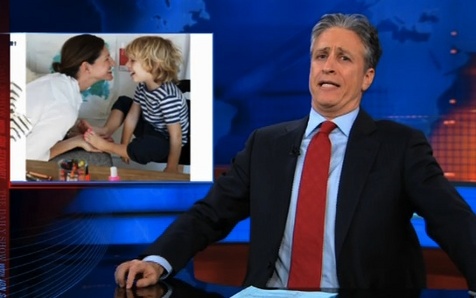
Click the photo for the inimitable Jon Stewart’s voice of sanity on this so-called “controversy”
J. Crew catalog: latest piñata 
for nutcases and their sticks

Poor advertisers. They never know when a nutcase will see in their work what isn’t there and then stir up a hornet’s nest. Like the time people saw Moonies and, another time, demonic symbols, in the consequently-retired Procter & Gamble logo.

The latest piñata against which the nutcases have blindly taken up their sticks? J. Crew. Their new catalog sports a photo of a Hallmark moment wherein company president and creative director Jenna Lyons is seen laughing with her five-year-old son, whose toenails happen to be painted.

But hold on! The boy’s toenails are pink. Worse, they are neon pink, which, if I understand correctly, is even more damning. Suddenly, Lyons finds herself accused of everything from “gender bending” to, in the irresponsible and intolerant words of Erin Brown of the Media Research Center, “…blatant propaganda celebrating transgendered children.” 

As of this writing, this silly non-story has made its way onto CNN, ABC, NBC and Fox — OK, that last one is not so surprising — some even branding it “a controversy.”

Really? A controversy?

Fortunately, a voice of sanity has emerged. I don’t care how busy you are — stop whatever you’re doing and click here for Jon Stewart’s master take on this one. (And, please, Ms. Brown, do not read anything into what may or may not rhyme with “master take.”)

—Steve Cuno
 
 
All children left behind
(and no more lives to live)
and more

All children left behind (and no more lives to live) — ABC is dropping soaps “All My Children” and “One Life to Live.” They are replacing them with cheaper-to-produce lifestyle shows about food and makeup. Chances are I still won’t be watching.

The Maytag Man has even less to do — Maytag is setting aside its never-breaks-down image to focus on the stuff people throw in the wash. I guess they anticipate that the fact that people use washers to wash clothes will be startling news.

Eco loco — Environmental groups are challenging CBS’s practice of attaching a green logo to certain ads. They claim the logo implies an environmentally friendly product, when in fact it may mean that the advertiser gives a percent of proceeds to an environmental cause. I welcome such challenges, even seemingly nit-picky ones. Inevitably, government ends up defining legal use of terms like “recycled,” “organic,” “natural,” “free range,” etc., etc. But therefore, also inevitably, lobbyists get involved. When they do, the result is loopholes that create a playground for weasels. For instance, a so-called “free range” dairy cow can be shackled in a barn, never allowed to see the light of day. How can this be legal? Because the law exempts lactating cows from that nasty requirement about “free range” cows having to be permitted to range freely. This is but one of myriad, insane examples of legal mislabeling.

Earlier this week it was my privilege to address the American Advertising Federation of Reno. I titled my presentation “Branding and Direct Response: There’s Room in the Sandbox for Both.”  I talked about what direct marketers could learn from branders, and vice-versa. The group was warm and welcoming, and, as far as I could tell from the podium, the presentation was well-received. I do quite a bit of public speaking, but speaking in Reno was particularly fun. I lived in Reno from age 11 to 21. I graduated from Reno High School and put in two years at the University of Nevada, Reno before finishing up at the University of Utah. It’s always fun to come home, but not often does one get to do so as an alleged “expert.” After the presentation, I visited some old haunts. The university, of course, is still there. But the mall where I sold shoes to earn my tuition? Not just changed, but razed. The site is nothing but a mall-sized gravel lot dotted with resting seagulls and surrounded by city. It was a bit surreal.

—Steve Cuno
 
 
Small world

Recently I received a call from a fellow who, having checked us out, emerged convinced that I am danged smart, and that the RESPONSE Agency might just be the direct response marketing firm his company should hire.

Bless that Internet. We get a lot of clients that way.

What makes this case unusual is that this fellow’s search just happened to lead him to the direct marketing agency with a blog post that his company would just as soon were removed. He confirmed that he would like to discuss the post, but indicated that its removal was incidental as to whether his firm would want to retain us.

—Steve Cuno
 
 
Picture
Do you believe these common psychology myths?

Myths about human psychology abound. The scary thing is, a good many have persisted so long as to now be accepted, unchallenged, as fact. 

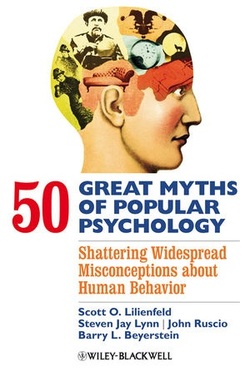
The book 50 Great Myths of Popular Psychology: Shattering Widespread Misconceptions about Human Behavior, by Scott O. Lilienfeld, Steven Jay Lynn, John Ruscio, Barry L. Beyerstein, is a great resource for setting the psychological record straight. It belongs on everyone’s bookshelf, marketers included.

If you don’t care to pick up the book, below is the table of contents, a mini-education in its own right. But I urge you to get the book. It adds explanations and perspective, plus includes oodles of  bonus myths at the end of each section.

— Steve Cuno

50 Great Myths of Popular Psychology:
Shattering Widespread Misconceptions about Human Behavior
Scott O. Lilienfeld, Steven Jay Lynn, John Ruscio, Barry L. Beyerstein

Table of Contents:

1 Brain Power.
 Myths about the Brain and Perception.

 #1 Most People Use Only 10% of Their Brain Power.
 #2 Some People Are Left-Brained, Others Are Right-Brained.
 #3 Extrasensory Perception Is a Well-Established Scientific Phenomenon.
 #4 Visual Perceptions Are Accompanied by Tiny Emissions from the Eyes.
 #5 Subliminal Messages Can Persuade People to Purchase Products.

 2 From Womb to Tomb.
 Myths about Development and Aging.
 #6 Playing Mozart’s Music to Infants Boosts Their Intelligence.
 #7 Adolescence Is Inevitably a Time of Psychological Turmoil.
 #8 Most People Experience a Midlife Crisis in Their 40s or Early 50s.
 #9 Old Age Is Typically Associated with Increased Dissatisfaction and Senility.
 #10 When Dying, People Pass through a Universal Series of Psychological Stages.

 3 A Remembrance of Things Past.
 Myths about Memory.
 #11 Human Memory Works like a Tape Recorder or Video Camera, and Accurately Records the Events We’ve Experienced.
 #12 Hypnosis is Useful for Retrieving Memories of Forgotten Events.
 #13 Individuals Commonly Repress the Memories of Traumatic Experiences.
 #14 Most People with Amnesia Forget All Details of Their Earlier Lives.

 4 Teaching Old Dogs New Tricks.
 Myths about Intelligence and Learning.
 #15 Intelligence Tests Are Biased against Certain Groups of People.
 #16 If You’re Unsure of Your Answer When Taking a Test, It’s Best to Stick with Your Initial Hunch.
 #17 The Defining Feature of Dyslexia Is Reversing Letters.
 #18 Students Learn Best When Teaching Styles Are Matched to Their Learning Styles.

 5 Altered States.
 Myths about Consciousness.
 #19 Hypnosis Is a Unique “Trance” State that Differs in Kind from Wakefulness.
 #20 Researchers Have Demonstrated that Dreams Possess Symbolic Meaning.
 #21 Individuals Can Learn Information, like New Languages, while Asleep.
 #22 During “Out-of-Body” Experiences, People’s Consciousness Leaves Their Bodies.

 6 I’ve Got a Feeling.
 Myths about Emotion and Motivation.
 #23 The Polygraph (“Lie Detector”) Test Is an Accurate Means of Detecting Dishonesty.
 #24 Happiness Is Determined Mostly by Our External Circumstances.
 #25 Ulcers Are Caused Primarily or Entirely by Stress.
 #26 A Positive Attitude Can Stave off Cancer.

 7 The Social Animal.
 Myths about Interpersonal Behavior.
 #27 Opposites Attract: We Are Most Romantically Attracted to People Who Differ from Us.
 #28 There’s Safety in Numbers: The More People Present at an Emergency, the Greater the Chance that Someone Will Intervene.
 #29 Men and Women Communicate in Completely Different Ways.
 #30 It’s Better to Express Anger to Others than to Hold It in.

 8 Know Thyself.
 Myths about Personality.
 #31 Raising Children Similarly Leads to Similarities in Their Adult Personalities.
 #32 The Fact that a Trait Is Heritable Means We Can't Change It.
 #33 Low Self-Esteem Is a Major Cause of Psychological Problems.
 #34 Most People Who Were Sexually Abused in Childhood Develop Severe Personality Disturbances in Adulthood.
 #35 People's Responses to Inkblots Tell Us a Great Deal about Their Personalities.
 #36 Our Handwriting Reveals Our Personality Traits.

 9 Sad, Mad, and Bad.
 Myths about Mental Illness.
 #37 Psychiatric Labels Cause Harm by Stigmatizing People.
 #38 Only Deeply Depressed People Commit Suicide.
 #39 People with Schizophrenia Have Multiple Personalities.
 #40 Adult Children of Alcoholics Display a Distinct Profile of Symptoms.
 #41 There’s Recently Been a Massive Epidemic of Infantile Autism.
 #42 Psychiatric Hospital Admissions and Crimes Increase during Full Moons.

 10 Disorder in the Court.
 Myths about Psychology and the Law.
 #43 Most Mentally Ill People Are Violent.
 #44 Criminal Profiling Is Helpful in Solving Cases.
 #45 A Large Proportion Of Criminals Successfully Use the Insanity Defense.
 #46 Virtually All People Who Confess to a Crime Are Guilty of It.

 11 Skills and Pills.
 Myths about Psychological Treatment.
 #47 Expert Judgment and Intuition Are the Best Means of Making Clinical Decisions.
 #48 Abstinence Is the Only Realistic Treatment Goal for Alcoholics.
 #49 All Effective Psychotherapies Force People to Confront the “Root” Causes of Their Problems in Childhood.
 #50 Electroconvulsive (“Shock”) Therapy Is a Physically Dangerous and Brutal Treatment.