Don’t tell anyone we told you, but our very own Steve Cuno wrote the byline-less Leader Column in the new issue of Deliver Magazine. Here it is. To read this piece in the online edition of Deliver, click here.

Let’s Hear It for Great Creative
Or, Don’t Shortchange the 20 Percent

By Steve Cuno

If you have worked in direct mail for more than a few minutes, odds are you have heard of the “Rule of 40-40-20.” It states that 40 percent of direct mail success depends on a well-targeted mailing list, 40 percent on a compelling incentive offer, and 20 percent on well-executed creative work.

We are all for any reminder of the importance of a solid mailing list and a sound offer as integral parts of a direct mail strategy. But beware inferring from the Rule — as some do — that the creative execution deserves no more than the least of your attention. 

The 40-40-20 breakout appears more symbolic than empirical, as shown by direct marketing pros who argue for a rule of everything from 60-30-10 to 70-20-10. But if direct marketers differ over ratios, most seem to agree on at least the gist of the Rule: that a well-targeted mailing list and a compelling incentive offer are crucial to a successful direct mail strategy. 

Good so far. But some marketers take the Rule of 40-40-20 a step further. Eighty percent isn’t bad, they reason, so why fuss over a mere 20?
 
It’s easy to imagine that such thinking might drive some of the lookalike direct mail all of us receive from time to time. Not just the layout, but even the copy appears cloned: “There’s never been a sale like this blah blah small type you have been pre-selected maybe perhaps to be considered for approval blah blah small type for all your needs blah blah small type we care, honest we do blah blah small type proudly serving you blah blah small type REPLY NOW.” If you suspect that the marketer doesn’t much care if you take in only the offer and “REPLY NOW,” you may be on to something. After all, with proper targeting and a hot deal du jour, the odds that you will respond increase accordingly. Even if the look and copy fall short of truly engaging you.

There is, of course, nothing wrong with doing direct mail that way. Especially when it proves profitable, as is does for many a marketer, and as it may well do for you. But before you get too far along with that approach, we hope you’ll search the pages of this and other issues of Deliver. You will find stories about direct mail pros who, after doing their homework to come up with a well-targeted mailing list and a desirable offer, set about crafting breakthrough, arresting, knockyersocksoff creative work with shine and appeal. And who, as a result, found themselves rewarded for it far beyond what they would have achieved relying solely on a great list and offer.

We wholly endorse the spirit of the Rule of 40-40-20. Due attention to the mailing list and offer is essential. But why risk shortchanging results by stopping there? While you’re at it, we recommend pouring your heart into the creative work. 

When you reap the rewards, let us know. You might just end up featured in Deliver. More important, you might just end up with an even healthier bottom line.
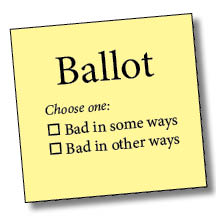
 
 
This election, may the less worse brand win. 
If only there were a way to tell which one that is.

Americans do not vote on issues. Not really. Not even Americans who are conversant with the issues and think they vote on the issues really do. 

There are a number of reasons this is so. 

One is that there are myriad issues but only—to speak of—two candidates. Though possible, it is statistically unlikely that either candidate’s position on every issue aligns with yours. If you do your homework and you’re honest about it, you will more likely find things you like and dislike about each candidate. Those things are likely to be apples and oranges, making them difficult to score and compare.

Of course, this all assumes that you understand issues. You don’t. Certainly not all, possibly not any. Issues are rarely simple, cut and dried. Details, ins and outs, underlying factors, agendas, implications, outcomes et al are largely misunderstood and in many cases largely unknown. That does not prevent warring parties from oversimplifying, obfuscating and spinning so that you think you understand, leading you to mistake the way someone has branded an issue for the issue itself. Yup. Even issues are brands.

Another reason is that there is no way to separate rhetoric from reality. Can your candidate truly fix the economy? Come on. Economies are chaotic systems. That is, they are subject to oodles of factors which not only affect the economy but affect one another, which affects how they affect the economy, which in turn affects them. The president is but one factor, a small one at that. Can your candidate influence the economy? Sure. To what extent? More than the other candidate? Had your candidate been in power earlier, would the economy be in better shape than it is now? Who the heck knows. Not that not knowing prevents anyone from pointlessly and unproductively arguing ad nauseam.

When all is said and done, we vote for the candidate who “feels” right to us. The brand. While some brands convey what they truly are and stand for, many convey what it takes to make the sale, true or not. Brand identity is not a reliable way to choose a bar of soap, much less a leader. However, and perhaps you know this, when you buy a leader the stakes are somewhat higher. 

I am not the first to raise these laments. Nor am I the first to admit that I am at a loss to come up with a better way to do it.

—Steve Cuno
 
 
Picture
Bad logic, bad science, and really bad taste. Fortunately, this one has not gone unpunished.
Another demonstration that 
not all publicity is good publicity

The First Amendment only precludes government restraint of speech. It does not preclude punishment, after the fact, at the hands of the offended.

A new case in point is Heartland Institute’s disgusting billboard. World renowned astronomer and rational thought champion Phil Plait reported it well in his Discover magazine blog, “Bad Astronomy.”  I am lucky enough to have met Phil (he is a wonderful soul) and I’m sure he won’t mind if I quote his blog below. (To read the whole thing, you’ll need to visit his original post. To cut to it right now, click here.)


—Steve Cuno

FOLLOWUP: 
Heartland Institute’s billboards 
are costing them donors
By Phil Plait

From his Discover magazine blog “Bad Astronomy”

I wrote a few days ago about the disgusting billboards put up by the far-right Heartland Institute, a climate-change denial group that apparently has no lower bounds to what they’ll do. The billboards, which went up in Chicago, likened climate scientists (and anyone who knows global warming is real) to mass murderers and madmen.

It was repulsive and hateful. After an uproar — and in less than a day — Heartland took down the billboards, but didn’t apologize for them. Instead they claimed it was an "experiment", and declared victory in getting attention. This would be why I use the words repulsive and disgusting.

But the damage was done — this tactic has backfired on Heartland... (read the rest of Phil Plait’s post by clicking here now)

Picture
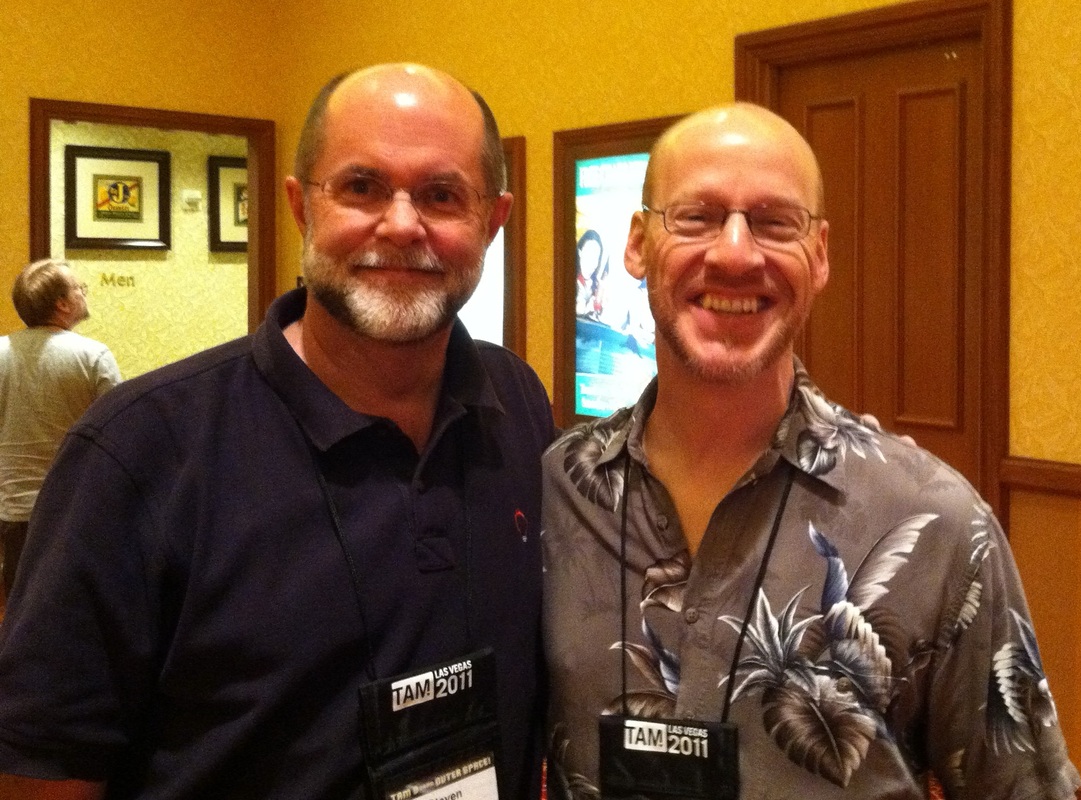
That’s Phil Plait on the right. I’m the guy on the left. (Told you I’ve met him.)
 
 
No lecture with this one. Just watch and enjoy.
—Steve Cuno


Sometimes the best 
marketing conferences aren’t 
really about marketing

Marketing is laden with folklore, most of it nonsense. Exposure to rational thought can inform your marketing strategies, ground you in the real world, and thus enhance your odds of success. If you find yourself in or near St. Louis, Missouri on Saturday, May 26, I urge you to show up at the St. Louis City Museum for the College of Curiosity. If you’re not planning to be there, consider changing your plans. 

I should add that while the one-day conference promises to be informative and horizon-broadening, it also promises to be FUN. Bring the children. Including your inner child.

You couldn’t ask for a better faculty—big-name scientists, artists, writers, doctors, stage magicians and more. The legendary St. Louis City Museum—part fun house, part art museum—provides the ideal setting. 

The impetus behind the College of Curiosity is friend and fellow rational thinker Jeff Wagg. Kudos to him. Too many rationalists, like me, sit comfortably at the computer and type stuff ruing the irrational world. A very few, like Jeff and wholly unlike me, get off their butts and actively promote rational thinking with events like this one. People like Jeff are wonderful and rare.

He deserves your support. At $30 for adults and $15 for kids, admission is eminently, almost shamefully reasonable. If you can possibly manage, attend. If you can’t make it yourself, send someone from your office.

—Steve Cuno
Schedule
9:00 – City Museum Opens
9:30 – Pre-Show with Jonny Zavant
10:00 – Welcome with Jeff Wagg
10:10 – Curious Flavors
10:15 – Anomalous Sounds with Brian Dunning
10:35 – A Curious Moment
10:40 – Life on Other Planets with Dr. Nicole Gugliucci
11:00 – A Curious Moment
11:05 – Alien Abductions with Kitty Mervine
11:25 – A Curious Moment
11:30 – Mathemagic with Ethan Brown
11:50  - Perception Science with Dr. Jennifer Newport
12:00  - Lunch (options TBA)
12:30 – Curious Videos
12:50 – Anomalous Sounds with Brian Dunning
1:10 – Learn Mental Magic with Jonny Zavant
1:30 – Comet Construction with Dr. Nicole Gugliucci
1:50 – Get Abducted with Kitty Mervine
2:10 – Become a Math Whiz with Ethan Brown
2:30 – Defying Gravity with Brian Dunning
2:50 – Closing with Jeff Wagg and the Faculty
3:00 – Exploration of the City Museum
4:00 – Curiosity Hunt
5:00 – Optional Dinner with Faculty
7:00 – Light’s Out! Flashlight Exploring of the Caves
Midnight – Museum Closes
 
 
Picture
Deliver doesn’t print by-lines on opinion pieces. But you have privileges: you’re allowed to know that the new issue’s Leader Column is written by Steve Cuno. To read this article on the Deliver site, click on the illustration above.
The Internet, Made for Direct Mail

Perhaps you have noticed that the Deliver magazine masthead includes the line “Mail marketing strategies from the U.S. Postal Service.” Given that our mission is to promote the responsible and effective use of direct mail, some may wonder why we feature an increasing number of articles about — even urging — mixing direct mail with online marketing tools.

Simple. We are passionate not just about direct mail, but about what works best in direct mail. As this and past Deliver issues report, many direct mail professionals are using the Internet to enhance effectiveness. If dovetailing with the Internet makes direct mail even stronger, we would be remiss in failing to talk about it.

Moreover, the public has begun voting with their wallets for the integration of direct mail with the Internet, and history attests to the dangers of resisting market demand solely for the sake of purism. Consider the well-known coffee chain whose CEO refused to offer lattes made with nonfat milk. Italian baristas didn’t use nonfat milk, he reasoned, so neither would his. In time he capitulated, but only after losing customers. Today, nearly half of the lattes and cappuccinos the chain sells are made with nonfat milk.

So if customers reward you for folding the Internet into a direct mail strategy, our official position is: Go for it. In addition to a coupon, phone number and First-Class Mail Business Reply Mail® card, consider providing direct mail recipients a link to a website or landing page. You could also up the ante with a personalized URL, so you can send readers to a landing page that mirrors your mailing and greets them by name.

Add a QR code, and without so much as entering a keystroke, the fast-growing smartphone crowd can immediately see your website, coupons, phone number, online video and more, and use the smartphone to respond.

There are other features you could add as well: Augmented reality codes, snap codes, and audio and video chips will each enhance your direct mail campaign. The spectrum of offerings is rapidly widening.

Direct mail is the original interactive medium. No amount of on-screen personalization, animation or wow-factor can match direct mail for tangibility. The more online communication waxes ubiquitous, the more we anticipate that direct mail’s unique and personal nature will have the advantage in terms of involvement and persuasion.

Yet wise integration of online tools into a direct mail strategy promises to make direct mail stronger than ever. As the public embraces the digital world, it only makes sense for savvy direct mail professionals to capitalize on the trend.

—Steve Cuno