Predictive Marketing Tip 2: Exercise a Bit of Control
It’s inevitable. Just when you’re about to celebrate an ad campaign that drove sales up, some naysayer will ask, “How do we know that sales wouldn’t have gone up anyway, even if you hadn’t run the ads?”
Resist the impulse to call the naysayer a … well, a naysayer. The truth is, it’s a fair question. It is entirely possible that sales went up due to some factor besides, or despite, advertising. I have pointed out before that gas mask sales rose dramatically about this time ten years ago. I doubt that gas mask ads had much to do with it.
So, how can you know? Set aside a small but representative, random sample of your market and insulate them from your advertising. Track this “control” group’s purchasing behavior along with that of those who are exposed to the ads. If the control group buys less, you can be pretty sure that the advertising led the larger group to buy more. If both buy at the same rate, your ads probably had no effect at all. If the control group buys more, your ads may be driving sales down.
The second and third possibilities occur more often than many of us care to know. This may be one reason why so few ad agencies track ad performance, much less use control groups. It’s easier to keep a campaign sold when the client can’t tell whether or not it’s accomplishing anything.
—Steve Cuno

Predictive Marketing Tip 1: To Succeed in Marketing, Try Proving Yourself Wrong
I would be flattering myself were I to open with, “As you may recall from my last post…” It’s not as if you have nothing better to do than read my posts, much less remember what I said in the last one.
So I shall refresh your memory. I promised to share a few tips for determining, in advance, if your marketing program will succeed. Here goes.
Tip Number 1: Try to prove yourself wrong.
I can hear Positive Mental Attitude aficionados the world over grinding their teeth. Such negative talk! But if you truly want to get to the facts, you’re better off seeking to prove your hunches wrong than right.
Here’s why. People tend to see what they want to see. Consider an overweight, balding man like the one in the picture above. Now suppose he thinks he’s young and virile. (Come on, admit it. You and I know people like that. Maybe we have even been “people like that” ourselves.) Now, if our friend gazes in the mirror with the intent of proving to himself that he “still has it,” there is a good chance that he will see exactly what he hopes to see. Something, perhaps, like this: That is why you should seek to prove yourself wrong. If your idea survives every challenge you throw at it, there’s a good chance you’re on to something viable.
Take, for instance, the Germ Theory of Disease. The first way someone tried to prove it wrong was by boiling linens and washing hands to show that infection rates wouldn’t go down. Except, they did go down. Later, when microscopes were invented, someone tried to prove the theory wrong by showing there were no too-small-to-see-with-the-naked-eye critters. But it turned out that there were such critters, and plenty of them. And so it went. After failure upon failure to disprove it, the Germ Theory of Disease became pretty well ensconced.
Want to know if your marketing idea will work? Try proving it won’t. If you succeed, you’ll be glad you found out before wasting money on it. But if you cannot prove it wrong no matter what you throw at it, you can proceed with a heightened degree of confidence.
—Steve Cuno
Don’t ask, “Do you think the marketing will work?”
Whether you, I or anyone else thinks that a marketing program will work is irrelevant. Either the campaign will work, or it won’t. It is a question of fact, not of opinion. Trouble is, the revelation of the fact lies in the future. So, here’s a better question: How do we find out if the marketing will work, and to what extent, before we bet the farm on it?
With a bit of creativity, there is a way to find out, in advance, if a marketing effort will work.
Hint 1: Don’t look to traditional research like focus groups, mall intercepts, online polls, and direct mail and phone surveys. Such may yield perspective, but are unreliable when it comes to predicting behavior.
Hint 2: Instead, find a way to put a valid sample of your market in what is, as far as they can tell, the genuine situation. Then, watch in secret to see what they do.
OK, that requires more than a bit of creativity. It requires a lot of it, not to mention discipline, patience, an open mind, and a basic understanding of how to conduct a controlled experiment. In the next few blog posts, I’ll share some tips as to how to go about it.
—Steve Cuno
Kudos to Netflix:A killer opening line. A willingness to be real.It’s hard to be human in advertising. It’s natural not only to hide our warts, but to pretend not to have any. And with the popularity of positive-mental-attitude nonsense, many of us fear reprisals from Karma should we dare utter any word that fails to brim with sunshine and lollipops. All the more reason that I admire Netflix for the email and blog post they published today regarding their rather unpopular recent price increase. The opening line? “I messed up. I owe you an explanation.”
Signed, no less, by Co-Founder and CEO Reed Hastings. When a guy opens with a line like that, it’s hard not to hear him out. Years ago, in a direct mail package for a client, I opened the sales letter with, “I’m a little embarrassed.” For that particular product in that particular vertical, the average response rate was 0.5%. My letter pulled 3.5%. I’m not great at math, but I believe that 3.5 is seven times greater than 0.5. It was — still is — the most successful direct mail package for that product in the client’s history. Yet they quickly abandoned it. Why? They preferred selling one-seventh as much to suggesting that their CEO, whose signature the letter bore, might be human. Kudos to Netflix for being real. To read the Netflix blog, click here.—Steve Cuno
Radio comment should be a “duh.” Which is why it’s worth thinking about.“Radio is a good, hard-working vehicle that’s great when you have something to say.” — Eddie Combs, Sears VP and CMO of home appliances, at the Radio Advertising Bureau and National Association of Broadcasters Radio Show earlier this week.I was going to nominate Mr. Combs for this week’s Duh Award. I mean, whoever heard of advertising when you don’t have something to say?
Oh, wait. It happens all the time. Coming up with “something to say” is hard work. Especially when the product is complex or, at the other end of the spectrum, a parity product. Rather than dig, too many creative types opt for substance-less, self-indulgently clever (as they suppose) fluff. They sell it to the client by claiming that the market will like the ad, remember it, and then buy “…without really knowing why.” Amazingly, clients fall for the rationale and run the fluff. If sales rise, they credit the fluff. If sales drop, they credit the fluff with having kept sales from dropping more. The fluff can’t lose. Don’t get me started. Instead, for an inspiring tale about an ad writer who insisted on digging deeper until he found something to say, click here and read the comment posted by Peter.—Steve Cuno
Cracker Barrel responds with class to a smart aleck (namely, me)
If you haven’t figured out that I’m a smart aleck, you are a new reader. (Welcome to the RESPONSE Agency blog, by the way.) I recently dashed off a tongue-in-cheek letter of pseudo-complaint to Cracker Barrel, whose restaurants rank high among my many weaknesses. They did a number of things well: - They replied.
- They replied promptly.
- They avoided typical corporate blither (like, “…sorry your experience wasn’t superb…we always strive to maintain blah blah blah...enclosed is a coupon for a free french fry…”).
- They addressed my specific complaint. For all I know, they have a standard letter for it. Fine. At least I could tell that someone at Cracker Barrel took the time to read and understand what I wrote. That’s called validating the customer.
- They apologized.
- They explained what was going on.
- They didn’t try to tell me I was wrong.
- Though I hoped for an equally tongue-in-cheek reply, they played it straight. That was probably wise. Out of context, humor is easily misinterpreted. I mean, for all they know, I am the sort of person who would post their reply online.
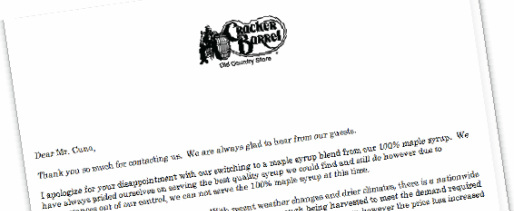
Here is my letter, followed by Cracker Barrel’s reply:
Dear Cracker Barrel: No complaints about the service, facility or food. Except for one thing. One really BIG thing. (Did I mention it’s big?) I just discovered that you no longer serve 100% pure maple syrup. With that single change, Cracker Barrel, once the last bastion of breakfast places where I didn’t have to pack in my own syrup, has tumbled from the acme of my good graces. You have no idea the personal trauma you have caused me. As I write, I stand atop my desk, ready to plunge to my doom on the carpet some 30 inches below. Oh, wait. I’m sitting at the computer. But maybe I’ll climb atop the desk after I press SUBMIT. You never know. No self-respecting connoisseur abides adulterated syrup. I plead with you to correct this heinous travesty. Return to your prior steadfastness in holding to serving the real stuff. Should you care to respond and I don’t reply, chances are I have been confined to a psych ward and denied computer access. You have only yourselves to blame. Kindest regards, Steve Cuno Once-loyal customer Here is Cracker Barrel’s reply:Dear Mr. Cuno, Thank you so much for contacting us. We are always glad to hear from our guests. I apologize for your disappointment with our switching to a maple syrup blend from our 100% maple syrup. We have always prided ourselves on serving the best quality syrup we could find and still do however due to circumstances out of our control, we can not serve the 100% maple syrup at this time. We do hope this elimination is temporary. With recent weather changes and drier climates, there is a nationwide shortage in the production of maple syrup. There just isn’t enough being harvested to meet the demand required to serve 100% syrup. Some grocery chains are still able to sell 100% maple syrup however the price has increased substantially. At Cracker Barrel Old Country Store, we decided instead of raising our prices and still having the potential to run out, we began searching for an alternative. After several focus group surveys, our guests picked the blend they thought most like our 100% syrup. Again, we are certainly hopeful for better harvests next season so that we can once again serve you the 100% maple syrup everyone likes so much. We look forward to having the opportunity to serve you again soon. Sincerely, Pam Seay Guest Relations Representative Cracker Barrel Old Country Store, Inc.
Tired of your own ads? You’re not the market.
Every ad agency has a tale of a client who wearied of a campaign and ordered it replaced, unaware that it had yet to run.
Given the quite human zeal for new-and-fresh, clients and agencies alike are tempted to replace a campaign just because it happens to be getting a bit old. On its own, that’s a pretty poor — and possibly counterproductive — reason to retire an ad campaign. A better reason to retire a campaign is that it fails to sell, has ceased selling, or doesn’t sell as effectively as its proposed successor. All of which assumes that the advertiser knows whether the campaign is indeed generating revenue. Most haven’t a clue.
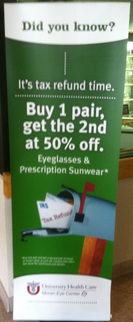
Still, there are times that it is appropriate to retire a campaign purely because it has been around too long. This morning, I snapped the adjacent photo. It’s a six-foot-tall sign in the lobby of the University of Utah Moran Eye Center. I have no problem with the concept of piggybacking on tax refunds. I have used that concept for clients myself. But either this poster has been up way too long, or it or went up way too early.
—Steve Cuno
Left: Pretty much throughout the United States, tax refund time tends to end before September.
How to get [this] small business to hire more people
Politicians are busily arguing about how to alter the tax structure to create more jobs for Americans. The idea behind the proposed cut du jour, this time on payroll taxes, is to motivate small employers to invest in hiring more people.
There is a name for that kind of thinking. Non sequitur.
If you lower what we employers shell out in taxes, I for one will be grateful. But it doesn’t follow that we will rush out and hire more people as a result. We will likely sit on the savings to hedge against an uncertain future.
Businesses hire when customers spend enough to keep more people busy and profitable. Lower payroll taxes all you want. But if more customers who buy more stuff don’t materialize, there’s no point to hiring, tax bargains aside.
If, Dear Legislators, you want employers to hire more people, focus your efforts on ensuring markets that will make it worth our while on a sustained basis. Sounds a lot like the Law of Supply and Demand. Duh.
—Steve Cuno
Marketing to both sides of the arms race
Turnitin brand software helps teachers nail students who plagiarize. Having listened to my brother, associate professor at a large university, describe tedious research involved in exposing a cheater, it sounds like a needful product.
But the same company also makes software called WriteCheck, which students use to find out if their plagiarisms are detectable by Turnitin. Thus alerted, students can edit their plagiarisms until they pass Turnitin’s muster.
Needless to say, some institutions of higher learning are neither amused nor pleased. I suppose it would be like a window replacement company selling errant baseballs, a toothpaste company selling sweets, or a police radar maker selling consumer radar detectors. (Having heard rumors about that last one, I researched it and found no evidence of it. Readers?)
—Steve Cuno
Beware the Pseudo-USP (Unique Selling Proposition)
Ever since Rosser Reeves wrote his classic book Reality In Advertising, it has been fashionable for marketers to bandy about “USP” as if they know what they’re talking about. Trouble is, most don’t. Many have never even heard of Reeves, much less read his book, as evidenced by the fact that they haven’t slightest idea of what a USP truly is. Or, for that matter, isn’t.
USP stands for Unique Selling Proposition. A USP is not a slogan or line. It is a strategic peg. It centers on a unique product feature (one-quarter cleansing cream), or one that is perceived to be unique (Techron), that is likely to motivate people to choose a brand.
So, let’s review. A bona fide USP is:
1. Unique. Or, perceived to be unique. Anyone can put cleansing cream in soap, but Dove has managed to take ownership of that feature.
2. A Selling Proposition. That is, it is likely to create brand preference. This can be tricky, because we humans are capricious. It makes intuitive sense that people concerned about skin care would like the idea of cleansing cream in soap. The success of wine in boxes has been more of a surprise.
Do not confuse a slogan for a USP. “We deliver,” “we care,” “trained professionals,” “only the finest ingredients,” etc., etc., are not USPs. For that matter, they are hardly slogans. They are recycled, meaningless fluff.
Neither do you have a USP if you come up with a line that is merely charming (“Happy cows” for California Cheese), that’s a groaner of a pun (“technology the world calls on” for Northern Telecom, “First relationships last” for First National Bank of Chicago), or that rings true only to the Board of Directors and their spouses (“pleasing people the world over” for Holiday Inn, “our people make the difference” for every self-indulgent company at some time or another).
A USP needn’t be a line, or anything remotely like a slogan. Rather, a USP is a claim. As long as it consistently underlies creative concepts and copy, you can vary how you express it. Over the years, Chevron has found lots of ways to talk about Techron, while the USP — that it keeps your motor running clean to make your car last longer — has held constant. Likewise, McDonald’s has found lots of ways to talk about cheap, fast and consistent food, yet never used any of those words in a slogan.
Next time your marketing committee (an oxymoron, incidentally) wants to brainstorm (ditto) a USP, raise a dissident voice. Hold out for a real USP. If, that is, you’re reasonably sure of not committing a career-ending act. Call me obsessive, but I can’t help thinking that when Reeves came up with the term “Unique Selling Proposition,” he was referring to claims that are both unique and a selling proposition.
—Steve Cuno
|