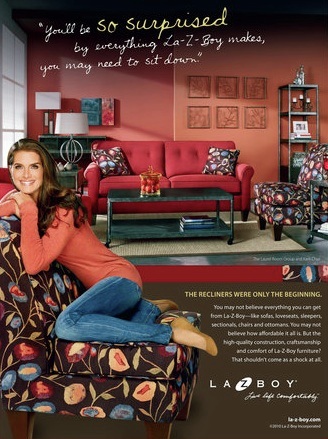
Orange juice isn’t just for breakfast anymore, and La-Z-Boy isn’t just recliners, either. La-Z-Boy and its agency RPA just signed Brooke Shields to encourage women to “Live life comfortably.” To do so, of course, women must understand that La-Z-Boy makes other kinds of furniture. 

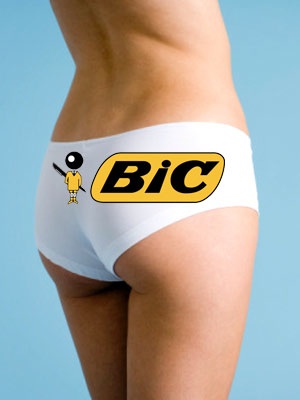
La-Z-Boy is not the first marketer to own a category and then try to break beyond it. The Bic pen people wanted to be known for disposable everything, not just pens. It worked with razors, but Bic brand disposable underwear didn’t catch on. (Really. I didn’t make that up.) 

La-Z-Boy is lucky to own the recliner category. I fear that by trying to broaden, they may stoke their egos but weaken their brand. For other kinds of furniture, they might be wise to introduce a new brand instead. But then, they didn’t ask me.

Mazda North America has switched marketing execs, hired a new agency and introduced new models, but they’re keeping “zoom-zoom.” I personally dislike the slogan, but that’s neither here nor there. The pertinent question is, does it sell cars? According to Advertising Age, the folks at Mazda believe that “zoom-zoom” has “done more to define the brand than the brand itself.” As soon as I make sense of that, I’ll let you know. 

My ongoing protest against misguided advertising awards. Box office success is helpful but optional when it comes to winning an Oscar. Advertising awards are not dissimilar, but should be. Recognizing creativity and execution to the exclusion of sales figures — common practice — does clients a disservice. 

The newest offense comes from the highly-regarded One Club for Art and Copy in New York, which just announced what it deems the top ten campaigns of the digital decade. Campaigns were chosen with no mention of results. Rather, judges from previous shows were asked to name their favorites. In other words, “Never mind how whether this campaign met its objective. I like this campaign, and that should be good enough to give it an award.”

I am the first to admit that winning awards is heady stuff. As a matter of policy, the RESPONSE Agency doesn’t enter the competitions. But sometimes clients have entered our work, and we have won. The trophies are around here somewhere. As an unnamed advertising executive once opined in Advertising Age: “Awards are meaningless. Except when I win one.”

—Steve Cuno
 
 
This is my just-published article in Deliver magazine. To read the article there and peruse the rest of the magazine, click here.

Dare I admit it? I once used “for all your needs” in an ad.

Stop building that scaffold and put away the noose. I was a brand-new copywriter. Lost on me was the fact that the phrase is meaningless.

Not that the inexperienced are the only ones who fall prey to platitudes masquerading as real claims. Copy cop-outs, as I like to call them, can take even seasoned writers unawares. It takes a vigilant, skeptical eye to spot them, skill to fix them and discipline to excise the ones that are beyond repair.

10 marketing copy phrases you should ditch

Here are 10 of my favorite (by which I mean most-loathed) copy cop-outs, along with recommendations for dealing with them:

1. “A tradition of.” If you think that tradition is a compelling copy point, you don’t know the fate of most fruitcakes given away each holiday season. The best way to improve this copy cop-out is to omit it.

2. “Experience the difference.” It’s better to show the difference. By promoting a no-questions-asked refund policy that included return-shipping charges, a mail-order retailer set itself apart without once using the “D” word.

3. “People serving people.” The people thing may work if your competition is known for hiring, say, feral cats. (Or, I suppose, if your market is cannibals.) Otherwise, delete this one, along with derivatives like “it’s our people” and “our people make the difference.”

4. “Simply the best” / “Best on the planet” / “Finest quality.” “Best” is hard to prove — and equally hard to swallow. But when you’re danged good, you can demonstrate it. If you apply three coats of paint and the standard is one coat, say so. If you use steel and the standard is plastic, say so. If your chef visits the market each morning to handpick tomatoes for that day’s pizza sauce instead of opening a can, say so.

5. “At a price you’re going to love.” Is that so? Then put the price in the ad and let people fall in love with it. Otherwise, don’t bring it up.

6. “Proud of.” With the possible exception of your parents, no one cares what you’re proud of. Instead, tell your customers what you’ll do for them.

7. “Professionals.” For doctors and lawyers, the claim is redundant. For teens in a lube pit, the claim is unbelievable. To inspire confidence, try something like this: “All employees receive a solid month of training and must pass a rigorous exam before we turn them loose under your car.”

8. “Friendly service.” A claim everyone ignores except when you blow it, at which time they will recall and mock it.

9. “Our name says it all.” Then stick only your name in the ad and be done with it. Very few advertisers do exactly that and prosper. I don’t recommend it.

10. “For all your needs.” I cannot close without offering a fix for my above-referenced youthful indiscretion. I suggest specifics. For instance, instead of “For all your foreign car part needs,” you might try “More than 100,000 hard-to-find foreign car parts in stock.”

We haven’t even gotten to “we mean business,” “let’s face it” and “excellence,” to name a few more. So many copy cop-outs, so little space.

—Steve Cuno
 
 
Read my new article for the James Randi Educational Foundation, “Of Belly Button Lint and Bogus Ads,” by clicking here now.

—Steve Cuno
 
 
Will you boycott the RESPONSE Agency after reading this? — Facing a threatened boycott by the American Family Association, Dick’s Sporting Goods changed holiday in an online promotion to Christmas. Fair being fair, I think we should boycott the American Family Association unless they change American to Extreme Christian. Last I checked, not all American families are Christian; nor do all Christians take offense at use of the word “holiday.” 

The post that won’t die --
For the most part, this blog comprises how-to’s, news and commentary on the subject of marketing. Yet the post that (still) pulls the most hits and comments, better than a year after its appearance, is this one about a company called G.W. Equity. Why, do you suppose?

Fresh from the Irony Department — Speaking of reader response to posts, yesterday’s offering on style generated unusual interest. Much of it came from people who resented being told to use a stylebook, and who should have consulted one before writing.

Text and the City — Sarah Jessica Parker is the new spokesperson for the Barnes & Noble Nook, a Kindle knock-off of sorts. Given that most book sales are to women — the last figure I saw was 79 percent — a female spokesperson may not be a bad idea. Whether Ms. Parker will work in that role is another matter. Of course, short of valid testing, all anyone can do is opine and infer. I prefer knowing, but then, B&N didn’t retain me.

Too bad you weren’t on Oprah today — Volkswagen of America would have given you a new Beetle.

How many online commercials can you take? — Turner Broadcasting and Magna Global conducted a test wherein they found that increasing interruptive commercials during streamed TV shows does not appear to diminish viewership. The test was done in the lab, however. It remains to find out what happens in the real world.

—Steve Cuno
 
 
I’m surprised at the number of professional writers who mess up the basics of style, such as where to place a period with parentheses. For Pete’s sake, grab a stylebook and use it. Sure, “correct” varies from one stylebook to the next, but it’s a start. Meanwhile, here are a few of my own, personal pet peeves:

Commas and periods go inside quotes:
OK: He said this is the “best possible scenario.”
NEVER: He said this is the “best possible scenario”.
OK: This is the “best possible scenario,” if you believe in such things.
NEVER: This is the “best possible scenario”, if you believe in such things.

Question marks can be tricky.
OK: Did he say this is the “best possible scenario”?
NEVER: Did he say this is the “best possible scenario?”
OK: He said, “Is this the best possible scenario?”
NEVER: He said, “Is this the best possible scenario”?

Periods with parentheses:
OK: The dog is friendly. (Even on Fridays.)
OK: The dog is friendly (even on Fridays).
NEVER: The dog is friendly (even on Fridays.)
NEVER: The dog is friendly. (Even on Fridays).

Semi colons: 
You can use them in academic or expository writing (like this); but in copy, they slow things down. Try shorter sentences, commas or, for a visual break, ellipses.
CORRECT BUT NOT GOOD: WuddaCleaner is great for removing ground-in dirt; for making dogs, cats and gerbils smell springtime fresh; and it tastes great on cereal.
BETTER: WuddaCleaner is great for removing ground-in dirt … for making dogs, cats and gerbils smell springtime fresh … and it tastes great on cereal.

Run-ons and commas:
Generally, if you have two complete sentences separated by a comma without a conjunction (like and, so, but or yet), you have a run-on:
     WRONG: Zest leaves no soap film, you’ll feel cleaner than ever.
You can fix it by breaking it into two sentences:
     OK: Zest leaves no soap film. You’ll feel cleaner than ever.
Or by inserting a conjunction:
     OK: Zest leaves no soap film, so you’ll feel cleaner than ever.
     OK: Zest leaves no soap film, you’ll feel cleaner than ever, and fleas will no longer congregate in your general area.
Sometimes writers use commas where they’d take a breath when speaking out loud. It doesn’t always work in print.
     WRONG: This, is the saddest day of my life. 
     OK: This is the saddest day of my life.
     OK: This, without doubt, is the saddest day of my life. 
     OK: “This,” he said, choking back a sob, “is the saddest day of my life.”
     OK: This is the saddest day of my life.

BIGGEST RULE OF ALL: Punctuate for clarity. Even if you have to break a rule to do it.
 
 
Picture
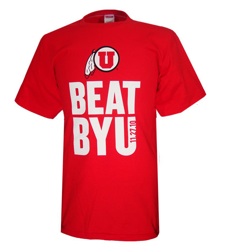
For the next week, the University of Utah and Brigham Young University will complete not just on the football field, but to see whose fans contribute more funds to the Utah Food Bank to feed the hungry. That’s what I call a worthy expression of rivalry. (Someone might want to suggest it to the Hatfields and McCoys. Maybe even to the Republicans and Democrats.)

Please click here for a choice of ways you can help. For instance, you can purchase a “Beat BYU” T-shirt (my personal favorite), bid for great items in the online auction, purchase a numbered tennis ball for a chance to win a $500 U of U Campus Store gift certificate, or cut to the chase and simply contribute outright

All proceeds go directly into empty stomachs. Thanks in advance.

—Steve Cuno
 
 
“Only ambitious non-entities and hearty mediocrities exhibit their rough drafts. It is like passing around a sample of your phlegm.”

—Vladimir Nabokov, quoted in a presentation by DM guru Alan Rosenspan


Today’s issue of Direct Marketing IQ quotes RESPONSE Agency chairman Steve Cuno along with other direct marketing experts on the use of the social media. 

In the article, Cuno says, “The social media are good news in that they are affordable, and that people flock to them. They are bad news in that people flock there to socialize, not to shop. That may seem like nothing new, since people don’t necessarily switch on the tube looking for your commercials, either. But DM commercials perform best when people tune in more to kill time than to find out what’s happening on Wisteria Lane. That’s why late-night placements pay out so well. The social media are so involving that your ad will have to work much, much harder to capture and hold attention long enough to create action.” 

Click here to read the entire article, written by Ethan Boldt.
 
 
I am often aghast at how easy it is to sell malarky, yet how difficult it is to sell common sense. Even to marketing decision-makers, who ought to know better.

Imagine you were a marketing consultant retained by company selling cheese in the United States. Suppose you had an idea: your client could package the stuff in a resealable plastic bag.

Not so fast. Before you up and say, “Why not sell cheese in resealable plastic bags,” consider ways of making your idea look like it’s worth more money. Maybe you could cloak your idea in language about “cracking the code” of the American cheese buyer. And maybe you could invoke an analogy. Let’s see… in Europe, people don’t refrigerate cheese; they keep it at room temperature, whereas Americans refrigerate cheese. Aha! There’s your analogy! In Europe, cheese is symbolically alive; but in the U.S., cheese is dead! Americans store cheese in a body bag (the zip lock bag) which they place in a morgue (the fridge). There’s your analogy. And, you can use it to claim you “cracked the code.” And to think you almost blurted out, “Sell cheese in resealable plastic bags, duh.”

If you think this sounds absurd, I agree. But this tale comes straight from recent marketing history. I just described the actions of a high-priced marketing consultant. Last I heard, he had a waiting list of eager clients hoping he will “crack” a “code” for them.

To be clear, we favor selling common sense at the RESPONSE Agency.

—Steve Cuno
 
 
Today I received an email from a fellow whose pleasure it was “…to inform you that you have been selected by the nomination committee to represent your industry in the Top 100 Business Leaders of 2010.” Odd that a personal note informing me of such a singular honor would say “your industry” instead of being more specific with, say, “marketing” or “advertising.” Perish the thought, but it was almost as if this were a generic email sent willy-nilly to masses of people. And here is an odd thing: they want me to send them my bio and my company name. I am very impressed that the nominating committee was able to select me without that information. 

This is just one version of many Who’s Who-type scams out there. The kind where you pay through the nose to have your name buried in a book whose pages are brushed with genuine gold-like leaf, a display case or stand for the book, a bookmark holding the book open to your page, a certificate, a certificate frame, extra books for your relatives and associates and their pets, directional signs to the shrine you build around the book, a kit and instructions for building the shrine, etc., etc.

As you doubtless have surmised, the book and accessories are not really what’s for sale. What’s for sale is ego gratification.

I once worked in a company where the boss bought into such a scam. He proudly displayed his book in the office on a pedestal the publisher sold him, open to the page where his name appeared in minuscule type among the names of a hundred thousand other dupes. He was fully convinced that Who’s Who had chosen him from among myriad, mega-qualified, daunting contenders. In reality, his name was on a mailing list of potential marks, and he bit. One helluva an egomaniac, my boss, perhaps he was the publisher’s rightful prey. 

But I have also known innocent people who, receiving such an invitation, genuinely believed that they — or, even sadder, that their child — had been singled out for a bona fide honor. Humble and grateful, they were ready to hand over their credit card number. It is not easy breaking the truth to them. 

Despite my use of the word “scam,” what these folks do is not illegal. They deliver exactly what they promise: they print your name in a fancy book. But the greatness of this so-called honor is entirely manufactured and vastly exaggerated. Which in my view makes their sales pitch look a lot like what ordinary people call “lying.” 

I am a direct marketer. I enjoy the craft. But I wish only practitioners with integrity would avail themselves of it. 

—Steve Cuno