From current issue of The New Yorker Magazine
Etch A Sketch and Brand Awareness Don’t get overly excited about this one
If you follow this blog, you know by now that increased awareness of a brand does not ensure increased sales of that brand. For a recent example, consider that as the awareness and popularity of Taco Bell’s spokesdoggy soared, sales plummeted. For an older example, consider that most people my age still fondly recall Alka-Seltzer’s “I can’t believe I ate the whole thing” campaign, which happened to drive sales down. And, as I have mentioned before, even Edsel continues to enjoy top-of-mind awareness.
But sometimes a mere surge in brand awareness will indeed spark sales all by itself. The latest example? Thanks to Mitt Romney advisor Eric Fehrnstrom’s likening his boss to the Etch A Sketch toy, Etch A Sketch sales have (reportedly) increased.
Confirmation bias-embracing ad agencies will doubtless try to use this as “proof” of the value of name recognition alone. Don’t be fooled; it proves no such thing. But as anecdotes go, it’s an enjoyable one.
—Steve Cuno

Don’t give up on direct mail. Email and texting have, ironically enough, given it renewed power. Is “poorly” executed direct mail working better? After better than a century of consistency (more or less), what works best in direct mail is changing. This can be disheartening to us oldsters who had hoped to learn the rules just once and be done with it. But whatever you do, don’t jilt direct mail for an exclusive relationship with the electronic media.
The catalyst for this post was a note from a friend and former associate: “We’ve started to get DM prospecting pieces around here that are executed weakly, but get opened because we don’t see much DM … Most of the mail is opened by skeptics who claim that they would never open DM, but they do … I’ve also read some anecdotal stories about a DM comeback.” I suppose fairness demands pointing out that if “skeptics who claim that they would never open DM” are opening the stuff, maybe it isn’t so weak after all. Of course, the acid test isn’t what gets opened, but what gets acted upon. To my friend’s first point, yup, direct mail use is waning. Diminished competition in the mailbox gives weaker stuff a better shot. But there’s another factor in the success of alleged weak stuff. We who have been in the biz for eons tend to weigh all direct mail against the Gold Standard, that is, the Classic Package: mailing envelope, sales letter, lift letter, brochure, business reply card. It became the Gold Standard because, for over a century, nothing could beat it. Alas, the Classic Package is losing its Gold Standard status. The power of the Classic Package resided in its resemblance to what people loved getting in the mail: a letter. There was no faster nor exciting way to receive personal communication from afar. Maybe it contained news, flirtation, a check, a photo, who knows what! Since it arrived but once a day, the anticipation was delicious. People looked forward to tearing into the envelope and discovering what wonders a letter on any given day might bring. Newer generations grew up in a different world. News, flirtation, check, photos, and who knows what arrive via email or text. And since they arrive not just once a day, but every minute all day long, well, so much for eager anticipation. By “newer generations,” I’m not referring only to my not-yet 10 years old, iPad-adept grandkids. (Who, incidentally, are cuter than yours.) For many up to about age 35, the classic package piggybacks on a fading or never-existed association. The romance just ain’t there. Yet marketers who jilt direct mail for a diet of electronic media-only may be shortsighted. Tangible mail has tricks up its sleeve that email and texting cannot pull off. Here’s a partial list of what direct mail can do that email and texting cannot: - Direct mail is not so easily deleted unexamined.
- You cannot do the mega-powerful lumpy mail with email or text messaging.
- You cannot enclose freemiums with email or text messaging.
- You cannot enclose samples, swatches, etc., with email or text messaging.
- You can use direct mail without fear of blacklisting by a server. This is especially useful for prospecting, not to mention for existing customers who forget they signed up to hear from you.
- Direct mail lets you take advantage of textured papers.
- Direct mail never has a problem with unloadable images.
- Direct mail can be as big (or small) as you want it, whereas electronic media are always confined to whatever size the monitor happens to be.
- Recipients can store mail in plain sight for future action.
- Direct mail always arrives. No passive system diverts it to a spam or junk file.
- Often people deal with email and text messages while doing other things. People go to the mailbox on purpose and look over each piece with deliberate, focused attention.
Finally, consider this: for younger people, something — anything — personally addressed in a mailbox is unique by definition in today’s world. Precisely because personally addressed mail is more unusual than it once was, receiving it can be cool, regardless of the format. Among younger folks there are more and more instances where the cost of a Classic Package is unjustifiable as compared with a postcard or self-mailer. But don’t rule out the Classic Package. And don’t rule out postcards, self-mailers et al simply because many in the industry used to disdain them. Today all of the above work. That is why the RESPONSE Agency suggests the Classic Package only as circumstances and numbers warrant. When other direct mail formats or electronic media are called for, we recommend as much. (And, I might add, we’re pretty darned good at all of the above.) We are not for tradition. We are for what works. Admittedly, part of me sighs wistfully as use of the Classic Package ebbs. The Classic Package is an art form that I love. Fortunately, there are still plenty of age 35+ people with spending money who readily respond to the classic package. Which means that we at the RESPONSE Agency get to have fun in all media. The occasional Classic Package is still part of the mix. —Steve Cuno
Note to copywriters: No one has to read your stuff.
Modern novelists who fail to hook you within 50 pages don’t deserve you. (I may be guilty of going easy on novelists.) An ad writer has no such luxury. The ad writer must hook you with the headline, keep you hooked to the last period of the body copy, and then get you to take action. No wonder so many ad writers hope to retire someday and write novels.
Prices So [---] Low
For nine years, British furniture retailer Sofa King has advertised prices that are “Sofa King low.” Last week, the UK’s Advertising Standards Agency (ASA) banned the slogan, ruling it “…offensive and unsuitable for general display … because the phrase could have been interpreted as a derivative of a swear word.” Gee, ya think?
In that moment, the ASA couldn’t have sounded more British.
That it took the ASA nine years to reach this conclusion serves to illustrate a point made by Mark Twain: “Why shouldn’t truth be stranger than fiction? Fiction, after all, has to make sense.”
—Steve Cuno
Me, writing, by the incomparable Britain Morris.
Alas, the words...
The sales letter seems to be a dying art. The problem — if you can call it one — is that databases and incentives increase sales more than good creative work. So, the ever-efficient, market-driven tendency is to rely on them, and to give but token attention to the sales letter.
But there looms the possibility of a lost opportunity cost. Experience shows that, once a good list and compelling incentive offer are in place, well-written copy can boost sales that much more. While leaving the list and offer untouched, I have more than once doubled sales by replacing a lousy sales letter with a powerful one. This applies to email, too.
—Steve Cuno
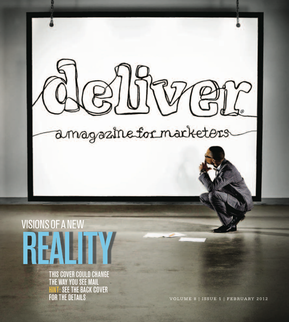
Invitations to write a Deliver magazine opinion piece sans by-line is an honor. In that moment, the U.S. Postal Service allows me to be their voice. Here is my Leader Column in the just-published issue. To read Deliver online or order the printed edition, click here. The Internet: Made for Direct Mail More than ever before, marketers need to seize on the natural symbiosis between direct mail and digitalPerhaps you have noticed that the Deliver magazine masthead includes the line “Mail marketing strategies from the U.S. Postal Service.” Given that our mission is to promote the responsible and effective use of direct mail, some may wonder why we feature an increasing number of articles about — even urging — mixing direct mail with online marketing tools. Simple. We are passionate not just about direct mail, but about what works best in direct mail. As this and past Deliver issues report, many direct mail professionals are using the Internet to enhance effectiveness. If dovetailing with the Internet makes direct mail even stronger, we would be remiss in failing to talk about it. Moreover, the public has begun voting with their wallets for the integration of direct mail with the Internet, and history attests to the dangers of resisting market demand solely for the sake of purism. Consider the well-known coffee chain whose CEO refused to offer lattes made with nonfat milk. Italian baristas didn’t use nonfat milk, he reasoned, so neither would his. In time he capitulated, but only after losing customers. Today, nearly half of the lattes and cappuccinos the chain sells are made with nonfat milk. So if customers reward you for folding the Internet into a direct mail strategy, our official position is: Go for it. In addition to a coupon, phone number and First-Class Mail Business Reply Mail® card, consider providing direct mail recipients a link to a website or landing page. You could also up the ante with a personalized URL, so you can send readers to a landing page that mirrors your mailing and greets them by name. Add a QR code, and without so much as entering a keystroke, the fast-growing smartphone crowd can immediately see your website, coupons, phone number, online video and more, and use the smartphone to respond. There are other features you could add as well: augmented reality codes, snap codes and audio and video chips will each enhance your direct mail campaign. The spectrum of offerings is rapidly widening. Of course, direct mail is the original interactive medium. No amount of on-screen personalization, animation or wow-factor can match direct mail for tangibility. The more online communication waxes ubiquitous, the more we anticipate that direct mail’s unique and personal nature will have the advantage in terms of involvement and persuasion. Yet wise integration of online tools into a direct mail strategy is inclined to make direct mail stronger than ever. As the public embraces the digital world, it only makes sense for savvy direct mail professionals to capitalize on the trend. —Steve Cuno
Marketing Tip: The Power of the “Ahhh”
I recently received a product by mail from a small family business. The owner had no better sense than to ask for my feedback. The thoughts I shared may prove useful to anyone who fulfills product orders via the U.S. Mail or other package delivery service.
Mail-order deliveries usually find a customer in one of two mindsets: either the customer has eagerly awaited the package, or has forgotten about it so that its arrival is something of a pleasant surprise. In either case, the customer opens the box with a sense of anticipation. Do not let your customer be unimpressed upon opening the box. You want your customer to open the box and see your product presented in a way that makes him or her exclaim, “Ahh.”
This is especially true for a food product, which this happened to be. Appearance affects perceived taste. If you don’t believe me, try serving — or drinking — milk that has been colored blue. Or consider myriad tests in which wine experts were certain they were drinking red wine when in reality they were served a white that was dyed red.
As for me, I was in eager anticipation mode when the package arrived. Unfortunately, I couldn’t hold back a wrinkled-up nose reaction upon getting the box opened. The product was swaddled in opaque pink bubble wrap that brought to mind Pepto Bismal—not the best initial association in any case, and especially for food. The Pepto cocoon sat by itself in an otherwise starkly empty box. Plus, the darned thing was taped together so tightly that, well, it was a good thing I had an Xacto knife on hand.
No one is better at mail-order food presentation than Harry & David’s. I’d recommend ordering a thing or two from them to see just how good they are at evoking that “ahh.”
Finally, some mail-order tips. You should enclose literature (again, professionally written and designed) that makes it easy to re-order and to buy other products. Include a coupon with an expiration date. A signed letter thanking the customer and telling a bit of the company story is always a good idea. Enclose a flier that suggests the stuff as a gift for family and friends.
Be sure every customer’s name goes into a database so you can mail or email them future offers. Note: the best time to get someone to make a purchase is right on the heels of their prior purchase.
—Steve Cuno
|