How not to win back lost customers
I just received another message from Consumer Reports. It seems they want me back. Much as AT&T did after I left them for Verizon.
Silly them. The “We want you back” strategy — if you can call it a strategy — overlooks a fundamental marketing principle. Namely, that I don’t give a darn, much less a damn, about what Consumer Reports, AT&T or anyone else wants. I care about what I want.
Smart, successful marketers speak to what customers want, not what marketers want. That is why you should never open your strategy planning sessions with the question, “What do we want to say?” Rather, open with, “What do our customers want?”
Ironically, when you set aside what you want for what your customers want, ultimately you end up with what you truly wanted in the first place: more customers.
—Steve Cuno

 Want to look this good? You could buy the product. But digital retouch is not included. UK nails L’Oreal for deceptive ads. Good.
Thanks to complaints from a UK watchdog group, cosmetic giant L’Oreal was forced to withdraw ads for their brands Mabelline and Lancome. The ads featured closeups of, respectively, supermodel Christy Turlington and actress Julia Roberts The charge? The ads impute that the cosmetics in question are the cause of the lovely faces in the photos, when in reality the photos were digitally retouched.
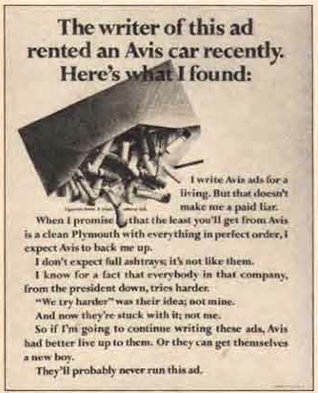
Good for the watchdogs. Given that the cosmetics purport to be all a woman needs to make her skin look great, no digital retouch should be required. Or, for that matter, allowed.  Rare honesty in advertising, courtesy of Avis. For an example of an uncommonly honest ad, consider this one, which appeared during the 1960s heyday of Avis’s still-famous “We try harder” campaign. Fifty years later, it still makes me chuckle. More important, running it may have added credence to the claims in their other ads.
—Steve Cuno
To know if advertising works, ask someone who measures effectiveness
Digging around in my archives this morning for something else, I happened upon this memo. I wrote it and sent it to my boss 24 years ago, when I was Intermountain Healthcare’s corporate advertising manager. I am sharing it with you today because the point still holds up.
I noted with interest an article on page 40 of the July issue of Hospitals magazine. The focus of the article is that 55 percent of hospitals do not track ad results. What I find interesting is that hospitals who do not track ad results rank advertising sixth as a marketing priority (on a par with word-of-mouth), while those who do track ad results rank advertising third, right behind quality of care and staffing.
In other words, those who have reason to know what they're talking about rank advertising higher than those who don’t.
—Steve Cuno
Step Back
Here’s a suggestion for more effective posters, billboards and vehicle wraps. Step back. Take a look at your work from a respectable distance.
What looks great up-close on a monitor may be illegible or indistinguishable once it’s plastered to a distant wall, hoisted onto a billboard, or wrapped around a trailer traveling down the freeway.
While you’re at it, remember that drivers have only a moment to glance at your layout. This is no time for subtlety or complexity. So, besides stepping back, be sure you have crafted a message that the average driver can take in with little more than a glance.
—Steve Cuno
 Torture test for smart phones: the Casio G’zOne Commando being strapped to a surfboard Does the new Casio smart phone ad campaign sound familiar?
The Unique Selling Proposition of a new Android-powered smart phone is its toughness. Using a classic product-demonstration style, TV and Internet spots show the Casio G’zOne Commando being strapped to a surfboard, the underside of a sports car and more, and surviving.
The approach may sound familiar to anyone who remembers the old Timex watch commercials. Watches shown to emerge intact from various forms of abuse were promoted with the still-famous tagline, “It takes a licking and keeps on ticking.”
(There is nothing new about new campaigns that smell like older ones. My generation easily recognized the Axe commercials from a few years ago as Hai Karate spots, back from the dead.)
For people who, like me, seem unable to pass up the least opportunity to drop their phones on hard surfaces, Casio’s appeal may work. On the other hand, smart phones are as much (or more) a fashion item as a bona fide need. In the marketplace, coolness often outranks practicality. If you don’t believe me, check out the heels on women’s shoes. Given that toughness-as-USP takes the practical approach, and that practical is not necessarily cool, I shall be eager to see if the campaign succeeds, and with whom.
—Steve Cuno
Customers aren’t free I am often struck by the number of would-be entrepreneurs who invest heavily to open a business, but fail to budget for keeping it open until it is profitable, much less for promoting it in order to speed profitability along.
Developing, packaging, inventorying and providing a product or service cost money. Moreover, those costs are up-front. You only become profitable as incremental profits from incremental customers spending a little here and a little there pile up over time.
A big duh? I agree. But, well, see Paragraph 1.
Customers rarely materialize from thin air. Something must bring them to you.
The “something” may be what is commonly called Word-Of-Mouth (WOM). Don’t believe anyone who tells you that WOM is the best form of advertising. Though arguably the most credible, it is also the slowest, the hardest to effect on purpose, and the hardest to control. If you are counting on WOM to work for you, be sure to budget sufficient funds to keep you in business until it kicks in. Assuming it does. And, given that the Internet is a tool of misinformation as much or more than of information, beware WOM that turns against you, merited or not.
The “something” may be a live sales force, whether in-person or on the phone. Live sales have built many a successful business. Just remember that you’ll have to pay for your sales force — not to mention phones, mileage reimbursements, uniforms, stationery, etc. — for a long time before they begin producing a return.
And, of course, the “something” may be advertising. That happens to be what we do here at the RESPONSE Agency, and it costs money, too. There’s serious money in creating it, and huge money in placing it where potential customers will see it.
Sadly, I often hear from a company only after it has found that WOM is taking too long, the sales force isn’t making headway, and money is thus at its thinnest. When I work up the cost of a testable, measurable, evidence-based direct response marketing program, they are aghast. “That much?” they gasp. Lost on them is that what I have proposed is a pittance compared with what they have already sunk into planning, development, production, packaging, inventory, facility, stationery, legal fees, rent, signs, personnel, etc.
So here’s a hint. When you’re in the planning stages, include marketing. That tends to work better than trying to add it later after your funds are gone.
Steve Cuno
From The Washington Post:Ubiquitous ‘tiny belly’ online ad part of scheme, government saysBy Paul Farhi, Published: July 6It might be the ad that ate the Internet.
“‘1 Tip for a Tiny Belly’ reads the headline, rendered in what appears to be hand-lettered type and positioned above a crudely animated drawing of a woman’s bare midriff. Try as you might to concentrate on something else, the midriff distracts your eye by shrinking and reinflating — flabby to svelte, svelte to flabby...
“The innocent-seeming ‘1 Tip’ ad is actually the tip of something much larger: a vast array of diet and weight-loss companies hawking everything from pills made from African mangoes to potions made from exotic acai berries. Federal officials have alleged that the companies behind the ads make inflated claims about their products and use deceptive means to market them. “The take so far: at least $1 billion and counting...” Read the rest of the article in The Washington Post by clicking here now.
Marketing abuses: the real and the imagined A recent study reported that test subjects who saw a sense-appealing popcorn commercial later recalled, incorrectly, having sampled the popcorn. Citing the study, The Skeptics Guide to the Universe podcast (SGU) , a reliable science show of which I’m (still) a huge fan, engaged in an ill-informed, sensationalistic rant about the manipulative powers of marketing. These folks do their homework and tend to know their stuff, so this was out of character. I wrote and sent the reply below. No word back just yet. Right up there with the Evil Scientist and Evil Skeptic is the Evil Marketer stereotype. When people ask what I do for a living, I sometimes wonder if I wouldn’t be better accepted if I said, “I steal wheelchairs from the non-ambulatory.” So, since I’m an admitted marketing guy, I anticipate that some listeners will dismiss what follows as naught but my paltry attempt to defend my evil ways. Alas. Last week’s discussion on marketing left me concerned that we may be warning people about non-existent or at least less-existent marketing dangers, while possibly diverting attention from a prevalent one. Marketers truly have a horrible and powerfully persuasive technique at their disposal. A good many wield it unabashed. But the technique doesn’t consist of manipulations that lure people unawares (which I’ll get to in a moment). It’s more blatant than that.
The technique to which I refer is called “lying.” A number of examples spring to mind: flimflam health products and treatments, diet plans, multilevel marketing schemes, mortgage scams, stock market buy/sell software, and anything even remotely connected to Kevin Trudeau. None of these marketers relies on the kind of sneaky manipulations discussed in last week’s podcast. They just out-and-out lie. And it works. Some lie legally, by use of omissions, weasels or tiny disclaimers that contradict the large print. Some lie illegally, playing the not-bad odds that regulatory agencies and class-action suits won’t catch up with them. Meanwhile, the public, feeling secure in the erroneous belief that caveat emptor is over and done with and that “ads can’t say what isn’t true,” hand over their wallets and, very often, their health or personal safety. So before we get too wrapped up in exposing subtle psychological manipulations — which few marketers use, and to little measurable effect — I think it’s important to alert the public to good old, old-fashioned lying — which lots of marketers use, and to great effect.
I’m not saying that marketers don’t look for ways to manipulate. They do. They conduct studies like the popcorn test cited last week, studies that track eye motion when people look at an ad or webpage, studies that track EEG readings while exposing people to ads, plus conduct oodles of focus groups, surveys and interviews, and more. Let them. The resultant manipulations and their alleged power are more the stuff of legend. I know this from my own work in tracking marketing performance, and from following the work of others who do likewise. Many allegedly successful marketing techniques — including those that sound like they ought to work, those that legend holds truly do work, and those that seem to have an effect in the lab — fail miserably in the real world. Tellingly, marketers who track sales directly attributable to their work tend not to bother with such studies and tactics. It is mostly academics, and marketers who resort to indirect measures (like recall or awareness scores), who are taken with them, and even these seldom use in actual practice what their tests allegedly show. Also telling is that articles about such tests and manipulations rarely show up in the marketing how-to trade press, but rather in the popular press instead. Here is what tracking consumer behavior in the real marketplace as opposed to in a lab continually reveals: a straightforward presentation of product features and benefits almost always outsells a would-be manipulative approach. Which means that a dishonest marketer is better off simply lying about features and benefits than troubling with psychological tricks.
That makes sense if you consider the testing environment as opposed to the real world. TV commercials, for instance, are tested in a darkened room where attention is focused on a screen. In the real world, a marketing message must fight for your attention between American Idol segments, at which time it is up against bathroom trips, fast-forwarding thanks to TiVo, channel surfing, mute buttons, conversations with others in the room, texting, checking in with Facebook, web surfing, flipping through a magazine, talking on the phone — or any possible combination of all of the above, all at once. If I told you that a hypnotist or psychiatrist could craft a 30-second message which, in that environment, could program you not only to want a product, but to go out days or weeks after being exposed to the message and buy the product without fully knowing why, you’d laugh me out the door. Yet, somehow, turning the villain into an evil marketer makes it seem plausible. One reason it’s easy to overestimate the power of marketing is that we see the hits while the misses are quietly retired. You probably haven’t heard much about Bic disposable underwear (yes, from the Bic pen people), Colgate frozen gourmet dinners (from the toothpaste people), or Gerber pureed creamed beef for single adults (packed in relabeled baby food jars). I’m not making those up. They were planned, tested, executed and marketed by experts with huge budgets and every trick of the trade at their disposal. Yet somehow the public managed not to be manipulated and responded with a resounding “no thanks.” Nor are such flops the exception. Marketing history brims with them. More products fail than succeed. More ad campaigns have no effect than positive effect. Some ad campaigns, even popular ones like the Taco Bell Chihuahua, actually drive sales down. Not too impressive for an industry that allegedly controls minds. For that matter, so-called successes are smaller than many might imagine. Prior to the current recession (I don’t have current stats), direct-mail credit card marketers celebrated if they pulled a 0.04% application rate with an approval rate of well under half. This “success” could equally be expressed as a 99.8% failure rate. Nor was it clear that the less than 0.02% who applied and were approved would become profitable cardholders. This is not an unusual example. I don’t mean to convey that no advertising works. Of course much of it does. But much more of it fails. Much more, in fact, than most people, advertisers included, realize. And successes tend to be incremental, not gargantuan. Nor do I mean to convey that there is no marketing knowledge as to techniques that tend to sell and techniques that tend not to sell. There is plenty. Most of it has to do with removing barriers, however, not with manipulation. An example of barrier removal: More people will call a toll-free number from a TV commercial when the number appears on-screen for 20 seconds and an announcer reads the number out loud three times. No manipulation there. It’s a simple case of making it easier for a viewer to write down a number. Here’s another one: Women’s clothing marketers find that when a man accompanies a woman to a clothing store, the woman is more likely to spend enough time to make a purchase if, right outside the dressing rooms, the man is provided with a chair and a TV tuned to a sports channel. Call it manipulative if you like. Most men call it merciful. But as for the likes of “if you can sneak your product into someone’s mind and get it to stick there, sales will go up,” “creativity sells,” or “people buy the sizzle, not the steak” and so forth: controlled, real-world tests show these things to be utter balderdash. Even though many marketers themselves believe them. Here is good news for those who insist that marketing in all its forms is the Antichrist: marketing techniques that have been validated in the real world are largely ignored by the lion’s share of marketers. That’s why you see so many commercials where a phone number appears for less than five seconds and is not read aloud at all, and why so few chairs and TVs are found near dressing rooms. This may seem surprising where profits are involved. But like most people, marketers prefer cool-sounding myths to banal facts. And many advertising agencies and marketing firms are only too happy to capitalize on their clients’ belief that what they do constitutes some kind of black magic. In fact, many advertising agencies and marketing firms believe it themselves. Like science, genuine marketing knowledge is no more nor less than that: knowledge. Just as we can use science to feed the hungry or blow up cities, we can use marketing to rip off the unsuspecting or to provide good information about good products. When skeptical organizations such as the James Randi Educational Foundation advertise The Amazing Meeting in Skeptic Magazine, the Skeptic’s Guide to the Universe sells fundraising seats at a dinner, George Hrab sells CDs, Free Inquiry magazine mails a subscription offer or, for that matter, when a commercial persuades me to see a movie or buy a product that I end up enjoying, these are all instances of, I hope you’ll agree, marketing’s good side. Not all, possibly not even most, marketers knowingly deceive anyone, but there is an overabundance of those who do. And, yes, we need to be concerned about other messages that marketers send, whether or not they directly affect sales. I’d encourage skeptics everywhere to go after deceptive and irresponsible marketers with a vengeance. This begins with not buying from them, followed by raising our voices against them. I try to do my part from the inside, as you’ll see from the links below.
But fair is fair. I’d also encourage skeptics to reward marketers who play nice. Thanks for indulging this lengthy response. I worry about having shortchanged my argument in an attempt to be even this brief. If you’d like details or wish me to back up any of the above claims, I’m at your service. Love the show. Please keep up the great work. Best regards, Steve Cuno P.S. In my own work, I take on the liars. Some links if you’re interested: http://www.delivermagazine.com/2011/05/how-ethical-is-your-direct-marketing/ http://www.directmarketingiq.com/article/on-morality-marketing-415891/1 http://adage.com/article/news/results-vary-ftc-rules/135227/ (scroll down to the comments section)
How not to advertise your auto dealership
If you want people to visit your auto dealership, may I suggest relevant advertising.
It’s not easy. When your competitors run irrelevant advertising — which they do, ad infinitum — it would be quite reasonable for you to assume that they know what they’re doing and imitate them.
I just passed a billboard showing a large photo of a side mirror, with a headline telling you that a dealer who listens is closer than it appears. I suppose the advertiser thinks the board is clever, which is debatable in and of itself. More to the point, the dearth of good-listener dealers is hardly a hot topic at the dinner table. Dealers who expect prospective car buyers to place hand on heart and say, “This, this is what I’ve been waiting for” are in for a disappointment.
Provided, that is, they know how to track sales from the campaign. Most don’t, so perhaps they are safe from disappointment after all.
Or, take the ubiquitous “service after the sale.” At least one dealer tried (and failed) to clever it up with “We back up every car we sell.” Given that most new cars come with a warranty, post-sale service is hardly a surprise. Do not count on it to serve as a Unique Selling Proposition unless and until your competitors run ads that say, “After the sale, go to hell.”
Then there’s “we’re not pushy.” There are three problems with that one: 1) These days, so many dealers push non-pushiness that it sets no one apart. 2) Even if it’s true that your sales staff never push, which I doubt, no one believes it. 3) Though the pushy dealer stereotype is a common consumer complaint, its lack is hardly a draw. So you don’t push? Fine. What do you do?
There is no shortage of dealers who blather about low prices. Advertising low prices builds a preference for comparison-shopping, but not for your dealership. Moreover, unless you’re Wal-Mart, “low price” comes off only as a token line that no one takes seriously.
Building a relevant brand for an auto dealership is difficult, especially since each line you carry comes with a brand of its own. That is precisely why so many dealers default to cleverness (or so they think) or showiness in hopes of attaining, substance aside, name recognition.
So, how do you create consumer preference for your dealership? See Paragraph Number One above: Try relevance. As for how you go about getting there, well, come on. You can’t expect me to give away every secret for free.
—Steve Cuno
|